Every serious tender explains how bids will be judged. Understanding this before you write a single page is one of the easiest ways to improve your results. The details vary by buyer and country, but most evaluations follow a similar pattern.
Stage 1: compliance check
Evaluators first check that your bid is complete and follows the instructions: the forms are signed, the required documents are attached, the bid security is in place and the bid arrived on time. This is a pass or fail step. A bid that fails here is usually not read any further, however good the price is.
Stage 2: technical evaluation
Next, your technical proposal is scored against the criteria in the documents. Typical criteria include relevant experience, the qualifications of your team, your method and work plan, equipment and resources, and understanding of the assignment. Many tenders set a minimum technical score, and bids below it are dropped before prices are opened.
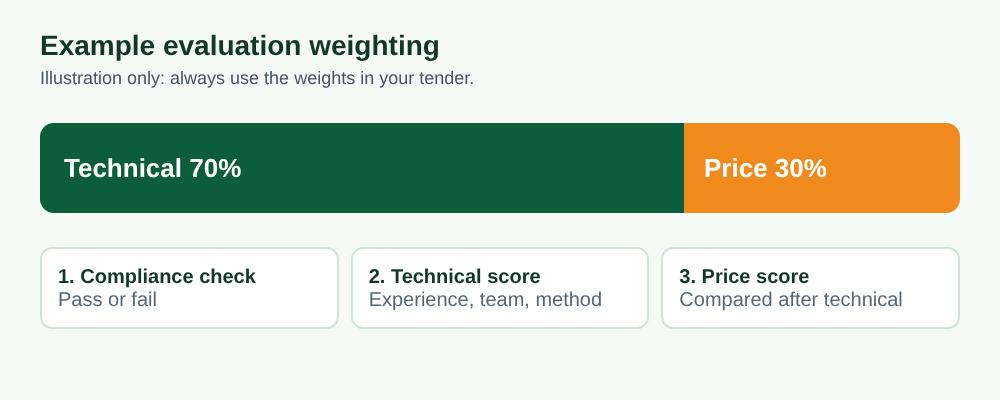
Stage 3: financial evaluation
Prices are compared after the technical stage. Arithmetic is checked and corrected where the rules allow, and the price is scored, often giving the lowest compliant price the maximum points. Some tenders award on the lowest evaluated price among bids that passed technical; others combine technical and financial scores with a stated weighting. The graphic above shows an example split only; always use the weights printed in your tender.
How to score higher
- Mirror the criteria. Use the evaluation criteria as your headings and answer each one directly, in the same order.
- Prove, do not claim. “Extensive experience” earns nothing. “Three similar contracts worth a combined K4.2 million completed since 2022, with reference letters attached” earns points.
- Show your plan. A clear work schedule, a risk list with how you will handle each risk, and named staff with roles show that you have thought about delivery.
- Make documents easy to find. Number the attachments and add a short index so evaluators can locate each item in seconds.
- Do not ignore small items. A missing page or a blank line can cost marks that a stronger competitor will collect.
- Price sensibly. Understand the real cost of delivery, including taxes, logistics and risk, and avoid a price so low that you cannot deliver.
Learn from every result
When you lose, request a debrief or read the evaluation report if it is published. Note which criteria cost you points and fix them in your standard bid file. Over a few tenders these improvements add up and move you from the bottom of the table to the top.
Browse every tender title free. Subscribe for full details, documents and a daily email of new tenders.
Browse tenders See plans