Winning a tender is rarely about being the biggest company. It is about reading the requirements carefully, proving that you can deliver, and presenting a bid that is easy for the evaluators to score. This guide walks you through a simple process you can repeat for every opportunity.
1. Decide whether the tender is worth your time
Before you spend days on a bid, check three things: does the work match what your business really does, can you meet the minimum experience and financial requirements, and is there enough time before the closing date? A focused bid for a tender you can win beats five rushed bids for tenders you cannot. Be willing to say no.
2. Read every document, twice
Download the full bidding documents and read them from start to finish: the instructions to bidders, the specifications or terms of reference, the evaluation criteria, the contract conditions and the forms. Highlight every requirement that says “must”, “shall” or “mandatory”. Note the closing date and time, the submission method, and any site visit or pre-bid meeting.
3. Ask questions early
If something is unclear, send a written clarification request before the deadline stated in the documents. Procuring entities usually share the question and answer with all bidders, which also shows you what competitors are asking. Never assume; a wrong assumption can make your bid non-responsive.
4. Build a simple bid plan
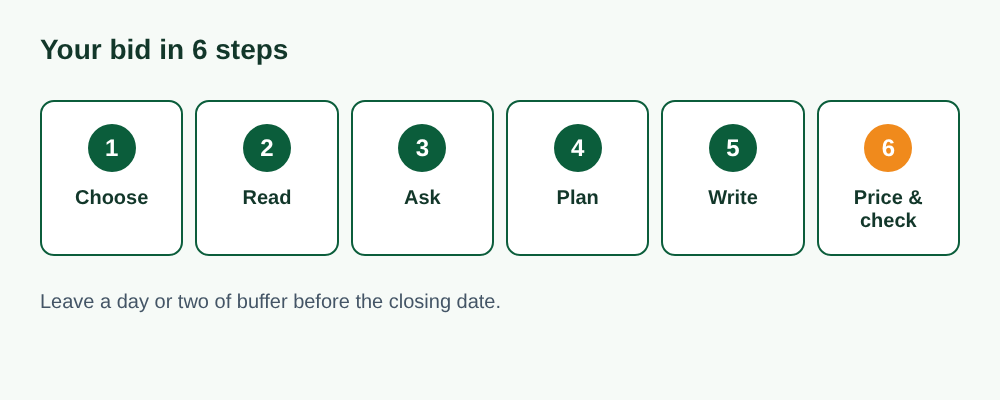
Work backwards from the closing date. Give yourself a day or two of buffer at the end, because printing, certifying copies, bank letters and delivery always take longer than expected.
- Who does what: assign the technical section, the pricing, the compliance documents and the final review to named people.
- Documents to request: start on tax clearance, bank letters, references and certificates early, because other offices control the timing.
- Review dates: book a review at least two days before submission.
5. Write for the evaluator
Evaluators score against a list. Make their job easy: follow the order of the requirements, use the same headings as the documents, and answer each point directly. Show relevant experience with real numbers, such as contract value, dates and the client’s contact. Explain how you will deliver: your team, equipment, schedule and how you will handle risks. Keep sentences short and avoid marketing language.
6. Price carefully, then check everything
Price every item in the format requested, include all taxes and costs the documents require, and check the arithmetic. A price that is far lower than the rest can look unrealistic, while one that is far higher will not score well. Finish with a compliance check: every form signed and stamped where required, every certificate valid on the closing date, the right number of copies, and the bid in the correct envelope or portal.
After you submit
Keep proof of submission. If you lose, ask politely for feedback and note where you scored lower; this is the cheapest training you will ever get. If you win, read the contract conditions again before you sign.
The businesses that win regularly are not lucky. They find tenders early, choose carefully, and follow the same careful process every time.
Browse every tender title free. Subscribe for full details, documents and a daily email of new tenders.
Browse tenders See plans